Finnish vs Estonian: How Similar Are They Really?
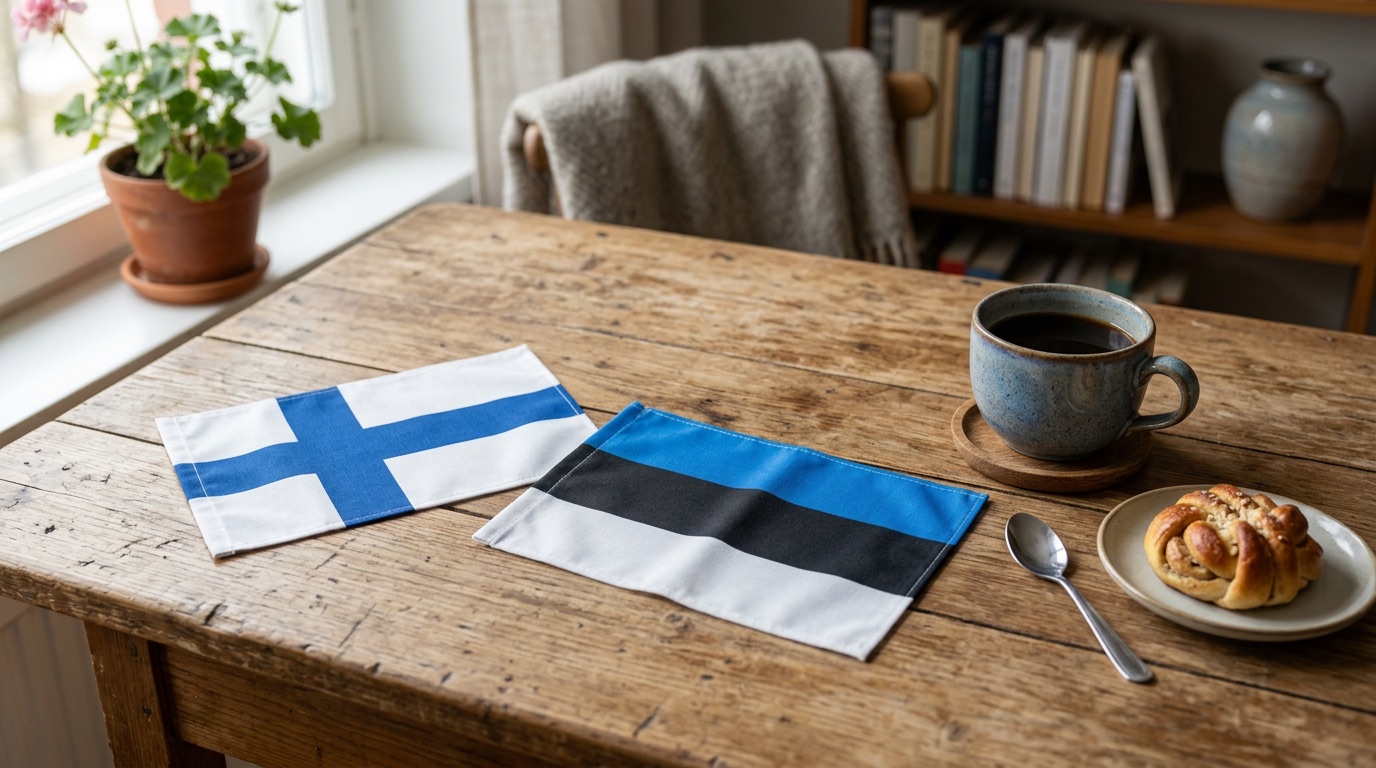
Finnish and Estonian are clearly related. They come from the same language family, share grammatical structures, and have a chunk of common vocabulary. But are they mutually intelligible? Can a Finn in Tallinn understand Estonians without studying? The answer is more nuanced than most people expect, and the differences are at least as striking as the similarities.
The family connection
Finnish and Estonian both belong to the Finnic branch of the Uralic language family. Their closest common ancestor, Proto-Finnic, diverged into separate languages roughly 2,000–3,000 years ago. That's a long time for languages to evolve independently.
For comparison: Spanish and Portuguese diverged from Latin roughly 1,500 years ago and are considered highly mutually intelligible. Finnish and Estonian have had an extra few centuries to diverge, and they've also developed under very different historical influences.
Finnish was influenced by Swedish (Finnish was under Swedish and then Russian rule for centuries). Estonian was more heavily influenced by Low German and then Russian. These different contact languages left significant marks on the vocabulary of both.

What's similar: the grammar backbone
The grammatical structures of Finnish and Estonian are strikingly parallel. Both languages:
- Have no grammatical gender
- Have no articles (no "the" or "a")
- Use case endings instead of prepositions (Finnish has 15 cases, Estonian has 14)
- Use vowel harmony (though Estonian's system has largely collapsed)
- Place strong stress on the first syllable
- Form compound words by combining roots without spaces
- Have similar question and negation patterns
If you've already studied Finnish grammar, picking up Estonian grammar feels like revising for a test you've already taken, with different answers for a few questions.
What's similar: core vocabulary
Many basic words are recognisably related, even if not identical:
| English | Finnish | Estonian |
|---|---|---|
| hand | käsi | käsi |
| fish | kala | kala |
| water | vesi | vesi |
| stone | kivi | kivi |
| night | yö | öö |
| year | vuosi | aasta |
| house | talo | maja |
| dog | koira | koer |
| I | minä | mina |
| to come | tulla | tulema |
The shared vocabulary tends to cluster around basic concepts, body parts, nature, family, basic actions. The further you go from the core vocabulary (into abstract concepts, modern technology, institution names), the more the two languages diverge.
What's different: the gaps that matter
Vocabulary divergence
Plenty of everyday words are completely different between Finnish and Estonian. This isn't just about sounding different, these words share no visible connection:
| English | Finnish | Estonian |
|---|---|---|
| yes | kyllä | jah |
| no | ei | ei (same!) |
| milk | maito | piim |
| bread | leipa | leib |
| city | kaupunki | linn |
| window | ikkuna | aken |
| beautiful | kaunis | ilus |
| thank you | kiitos | aitäh |
Sound system differences
Estonian has three vowel quantities (short, long, overlong) which Finnish doesn't have. This "overlong" third tier means Estonian words can have three distinct vowel lengths where Finnish only has two. To Finnish ears, this makes Estonian sound rhythmically unusual, and to Estonian ears, Finnish can sound "flat".
Estonian also dropped vowel harmony almost entirely. While Finnish strictly requires front/back vowel consistency in suffixes (you say talossa but pöydässä), Estonian uses the same suffixes regardless. For learners of Estonian coming from Finnish, this is actually a welcome simplification.
False friends
Perhaps the most dangerous similarity: false friends, words that look alike but mean something different.
- Finnish koulu = school. Estonian kool = school. (Same! A true friend.)
- Finnish hallitus = government. Estonian hallitus = mould (as in fungus). Government in Estonian is valitsus.
- Finnish armas = dear / beloved. Estonian armas = dear / beloved. (Same!)
- Finnish mees (dialectal/archaic for man). Estonian mees = man. (Same!)
- Finnish kuul doesn't exist. Estonian kuul = moon / month, while Finnish uses kuu.
Can Finns understand Estonian, and vice versa?
Partial mutual intelligibility exists, but it's limited and asymmetric. Most linguists estimate 50–70% lexical similarity between Finnish and Estonian, but intelligibility in practice is much lower than that number suggests, because the words that differ tend to be high-frequency everyday words.
A Finn reading a simple Estonian text might understand 30–40% without any study. An Estonian reading Finnish might do similarly. In spoken language, the different pronunciation patterns make it even harder, the rhythm and sound of spoken Estonian is quite different from Finnish even when the words are similar.
Finns and Estonians who work together regularly often report developing a functional understanding over time, especially with shared vocabulary for work concepts. But "understanding" in this case usually involves a lot of guessing, slow speech, and goodwill on both sides. It's not like Dutch speakers talking to German speakers.
Which is harder to learn?
For an English speaker starting from zero, Finnish and Estonian are roughly equally difficult, both sit at FSI Category IV. Estonian may have a slight edge for one reason: the collapse of vowel harmony means one less system to learn. But Estonian's three-way vowel length distinction adds its own challenge.
If you already know Finnish, Estonian is significantly easier to pick up, you have the case grammar framework, the Finnic vocabulary base, and the stress pattern already. Most fluent Finnish speakers report reaching functional Estonian (A2–B1) within 6–12 months of focused study. The reverse is equally true.
Does knowing Estonian help you learn Finnish?
Yes, more than knowing most other languages. The grammatical framework transfers directly: you already understand what a case system is, how it works, how to decline nouns, how verb conjugation differs from English. You also have a head start on core vocabulary.
That said, the vocabulary differences are substantial enough that you can't coast. And the vowel harmony system is essentially new learning if you come from Estonian. But the total effort to reach Finnish B1 from Estonian B2 is significantly less than starting from English zero.
Which should you learn?
The answer is simple: learn whichever one you actually need. If you're moving to Finland, learn Finnish. If you're moving to Estonia or working with Estonian companies, learn Estonian. The language of the country you live in matters far more than which is "easier" or "more similar to your existing languages".
If you genuinely have no geographic or practical preference and are curious about the Finnic language family, Finnish tends to have more learning resources available in English, more apps, more courses, and a larger global community of learners. That might tip the balance.
Learn Finnish with structured, CEFR-aligned lessons
SuomiSpeak covers the full Finnish journey from A1 to B2, grammar, vocabulary, listening, and speaking practice built around how Finnish actually works. Free to start.