All 15 Finnish Noun Cases Explained (With Examples)
Finnish has 15 grammatical noun cases, and it is one of the most common reasons people say Finnish is hard. Here is the truth: each case has a clear purpose, and once you understand what it does, you can learn it systematically. This guide covers all 15, with plain explanations and real examples you will actually meet.
Why Finnish has so many cases
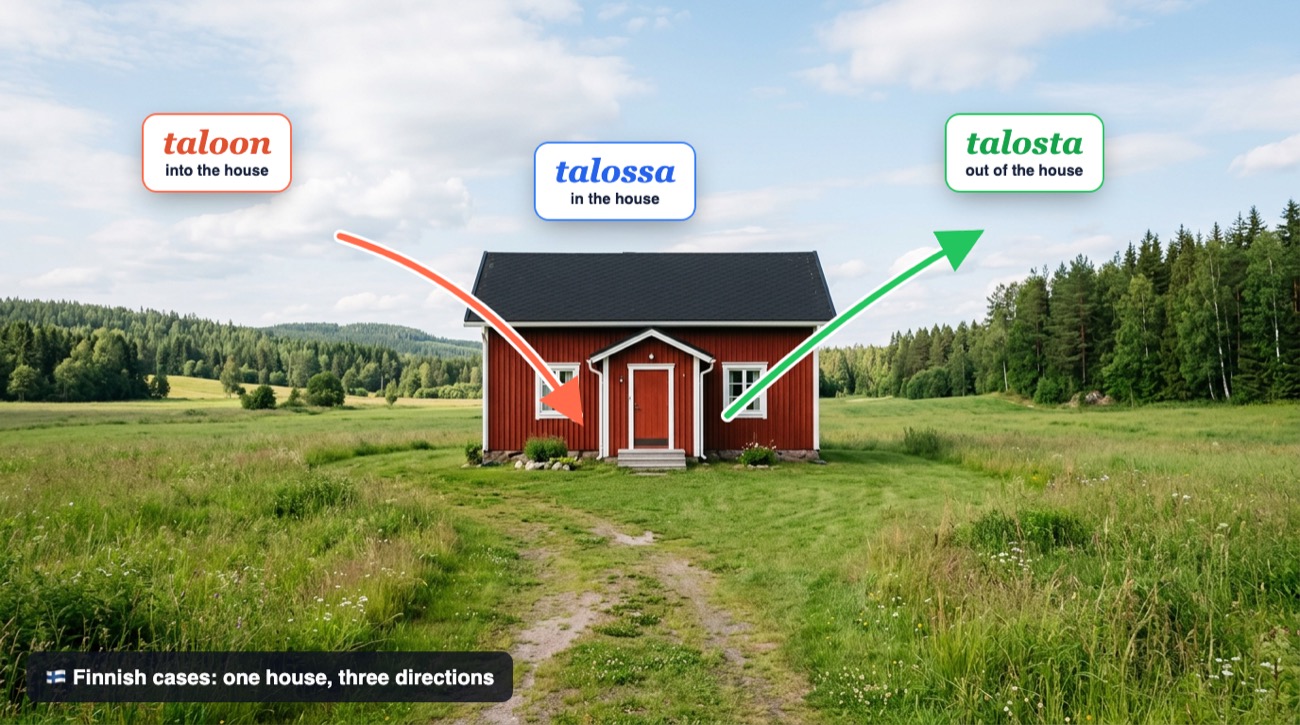
In English we use prepositions: "in the house", "from the house", "into the house". Finnish skips prepositions almost entirely and changes the ending of the noun instead. Each ending signals a different relationship. That is a case.
The good news: once you learn an ending, it applies to almost every noun consistently. Finnish is actually very regular. There is no gender, no articles, and the patterns are predictable.
The 15 cases at a glance
| Case | Ending | Meaning | Example |
|---|---|---|---|
| Nominative | (no ending) | Subject (who or what does it) | talo (house) |
| Genitive | -n | Possession (of, 's) | talon (of the house) |
| Partitive | -a / -ä / -ta / -tä | Partial amount, negation, uncountable | taloa (some house) |
| Accusative | -n / (no ending) | Direct object (complete action) | talon (the whole house) |
| Inessive | -ssa / -ssä | In (inside something) | talossa (in the house) |
| Elative | -sta / -stä | Out of / from inside | talosta (from the house) |
| Illative | -an / -ään / -han | Into / movement inside | taloon (into the house) |
| Adessive | -lla / -llä | On / at (surface or location) | talolla (at the house) |
| Ablative | -lta / -ltä | From (a surface or person) | talolta (from the house) |
| Allative | -lle | To / onto (a surface or person) | talolle (to the house) |
| Essive | -na / -nä | As / in the role of | talona (as a house) |
| Translative | -ksi | Becoming / changing into | taloksi (into a house) |
| Instructive | -n (plural) | By means of / in what manner | jaloin (on foot) |
| Abessive | -tta / -ttä | Without | talotta (without a house) |
| Comitative | -ne- | Together with / accompanied by | taloineen (with its house) |

The 6 cases you will use most
Do not be overwhelmed. In everyday Finnish, you will use these six constantly.
1. Nominative, the base form
This is the dictionary form, used for the subject of a sentence: whoever or whatever is doing the action.
Koira juoksee. The dog runs. (koira = dog, nominative)
2. Genitive, possession
Add -n to show ownership or connection. It is used far more than English "of": it also appears after many verbs and with numbers.
Koiran nimi on Musti. The dog's name is Musti.
3. Partitive, the trickiest one
The partitive is used for partial amounts, ongoing actions, negations, and uncountable things. It trips up most learners, and it is the one that needs the most practice.
Juon kahvia. I am drinking (some) coffee. (ongoing, uncountable)
Ei ole taloa. There is no house. (negation)

4. Inessive, in something
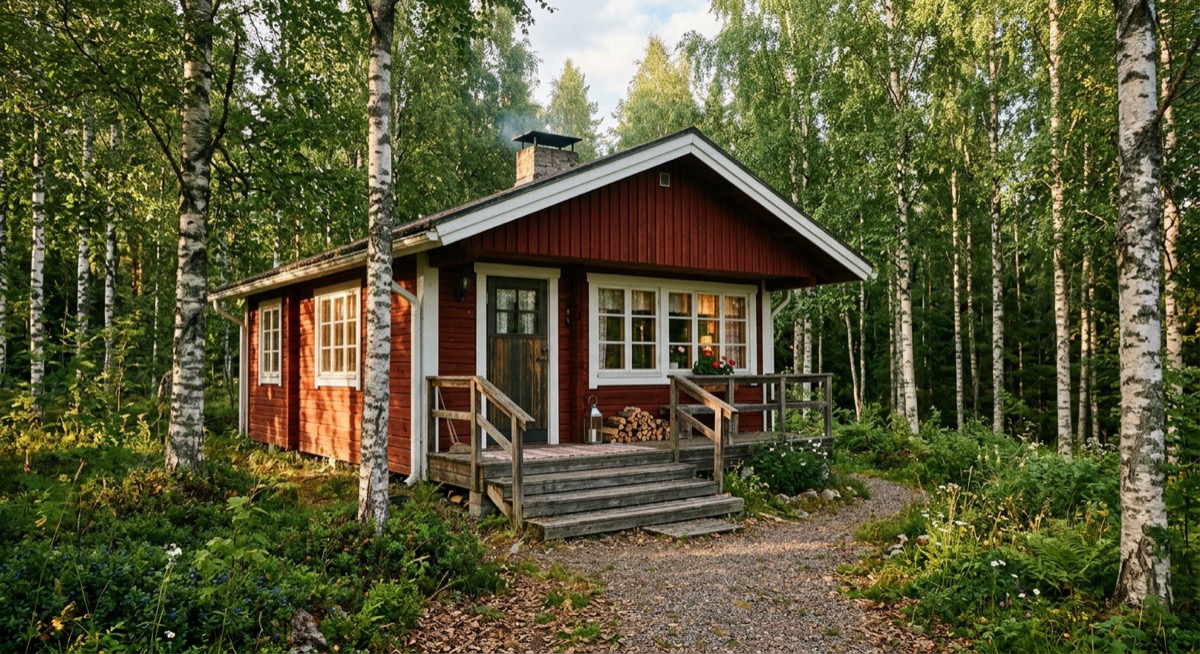
Add -ssa/-ssä (vowel harmony) to mean "inside" something.
Olen kaupassa. I am in the shop.
5. Adessive, on or at
Add -lla/-llä for being on a surface or at a place. It also expresses having something: Minulla on auto, I have a car.

6. Illative, going into
Movement into something. The ending varies by word, which makes this one of the more irregular cases to learn.
Menen kotiin. I am going home.
The 4 cases you should learn next
After you are comfortable with nominative, genitive, partitive, inessive, adessive, and illative, these four come up often enough to prioritise.
7. Elative, out of or from inside
Add -sta/-stä for movement out of something, or the source of something.
- Tulen kaupasta. I am coming from the shop.
- Hän tuli talosta. She came out of the house.
- Pidin siitä elokuvasta. I liked that film. (liking uses "from" in Finnish)
The elative also appears with many verbs of liking, talking about, or being interested in: Puhutaan säästä, let's talk about the weather.
8. Ablative, from a surface or person
Add -lta/-ltä for movement from a surface or from a person.
- Otan kirjan pöydältä. I take the book from the table.
- Sain viestin Petralta. I got a message from Petra.
- Miltä se maistuu? What does it taste like? (literally "from what does it taste")
9. Allative, to a surface or person
Add -lle for movement to a surface or towards a person.
- Laitan kirjan pöydälle. I put the book on the table.
- Soitan Marialle. I will call Maria.
- Hän meni rannalle. She went to the beach.
10. Translative, becoming or changing into
Add -ksi to describe becoming something or changing into a state.
- Hän tuli lääkäriksi. She became a doctor.
- Maali muuttui siniseksi. The paint turned blue.
- Käänsin sen suomeksi. I translated it into Finnish.

The rarer cases
The remaining 5 cases (essive, instructive, abessive, comitative, and the accusative as a distinct form) appear less often in everyday speech. Some live mostly in formal writing, fixed phrases, or literary language. You will meet them naturally as you reach B2 to C1 level, so there is no need to drill them in your first year.
The essive (-na/-nä) describes a temporary state or role: opettajana, as a teacher; lapsena, as a child.
The abessive (-tta/-ttä) means without: rahatta, without money. In spoken Finnish, this role is usually handled by ilman (without) plus partitive instead.
The comitative (-ne-) means together with, and it is rare enough that even many Finns avoid it in speech: taloineen, together with its house. In everyday language, yhdessä or kanssa (with) carries this meaning.
How cases interact, the things textbooks skip
Understanding each case in isolation is the first step. Understanding how they interact is what takes you to fluency. Here are the most important rules.
Negation always triggers partitive
Whenever a sentence is negated, the object shifts to partitive, no matter what case it would normally take.
- Ostan kirjan. (I buy the book) accusative/genitive form
- En osta kirjaa. (I don't buy a/the book) partitive after negation
- Hän on kotona. (He is home) becomes Hän ei ole kotona. (no case change here, location stays the same)
Partitive for ongoing, accusative for completed
The choice between partitive and accusative for objects signals whether an action is complete or ongoing.
- Luen kirjaa. I am reading a book (ongoing, partitive)
- Luen kirjan. I will read the book (completely, accusative)
- Juon kahvia. I am drinking coffee (ongoing, some)
- Juon kahvin. I will drink the coffee (all of it, done)
Location vs movement: internal vs external
Finnish has two parallel sets of local cases: one for inside things, one for surfaces and general proximity.
| Direction | Inside (-ssa group) | On / at (-lla group) |
|---|---|---|
| Being in/at | inessive: talossa (in the house) | adessive: talolla (at the house) |
| Moving out/from | elative: talosta (from the house) | ablative: talolta (from the house-area) |
| Moving into/to | illative: taloon (into the house) | allative: talolle (to the house) |
The rule of thumb: use -ssa/-sta/-on for enclosed spaces (inside a room, a building, a country), and -lla/-lta/-lle for open areas, surfaces, and people.
Vowel harmony and cases
Almost all case endings have two forms, one for back vowel words and one for front vowel words. The rule: if the word contains a, o, u, use the back vowel suffix; if it contains ä, ö, y, use the front vowel suffix.
| Case | Back vowel (a/o/u) | Front vowel (ä/ö/y) |
|---|---|---|
| Inessive | -ssa | -ssä |
| Elative | -sta | -stä |
| Adessive | -lla | -llä |
| Ablative | -lta | -ltä |
| Partitive | -a / -ta | -ä / -tä |
| Translative | -ksi | -ksi (same) |
| Essive | -na | -nä |
Words with only e and i vowels take front vowel suffixes. When in doubt, say the word out loud: if it sounds natural, it probably is.
How to actually learn the cases
Reading a table will not make cases stick. What works:
- Learn in context. See each case used in real sentences, not just as an abstract suffix.
- Drill one at a time. Focus on nominative and partitive first, then add cases one by one.
- Speak out loud. Production builds automaticity faster than recognition.
- Use spaced repetition. Review cases you have learned before moving on.
Practise every case in the app
SuomiSpeak has a dedicated drill for all 15 cases, with audio and real examples, from nominative to comitative.
Frequently asked questions
How many noun cases does Finnish have?
Finnish has 15 grammatical noun cases. Each case changes the ending of nouns, pronouns, and adjectives to signal their role in the sentence, replacing the prepositions used in English. The most common cases in everyday speech are the nominative, genitive, partitive, inessive, adessive, and illative.
What is the partitive case in Finnish?
The Finnish partitive case (ending -a/-ä or -ta/-tä) is used for partial amounts, ongoing or incomplete actions, negation, and uncountable nouns. For example: 'Juon kahvia' (I am drinking coffee, ongoing) vs 'Juon kahvin' (I will drink the coffee, all of it). The partitive is also always used after negation: 'Ei ole taloa' (there is no house).
Do you really need all 15 Finnish cases?
In everyday spoken Finnish, you will use about 10 cases regularly. The remaining 5 (instructive, abessive, comitative, and some uses of essive and translative) appear mainly in formal writing or fixed expressions. For A1 to B1 level, focus on the 6 most common: nominative, genitive, partitive, inessive, adessive, and illative. The rarer cases become relevant at B2 to C1.
What is the hardest Finnish case to learn?
Most learners find the partitive the hardest. It has multiple uses (partial amounts, ongoing actions, negation, uncountable nouns) and the rules for when to use partitive vs accusative are subtle. The illative is also challenging because its ending varies irregularly: taloon, kaupunkiin, maahan.
What is vowel harmony in Finnish cases?
Vowel harmony means Finnish case endings have two versions, one for words with back vowels (a, o, u) and one for words with front vowels (ä, ö, y). For example, the inessive is -ssa for back vowel words (kaupassa, in the shop) and -ssä for front vowel words (pöydässä, on the table). Native speakers say the wrong version sounds obviously off, so it becomes intuitive with practice.